
What Can You Fit Inside the 2027 Ford Expedition?
What Can You Fit Inside the 2027 Ford Expedition? A Guide for Enterprise Shoppers
Contact Us Our Inventory
If you're considering purchasing the 2027 Ford Expedition, this overview from Gilland Ford will provide you with all the information you'll need about the amount of cargo space it has available!
Behind 3rd row (21.6 cu ft) — Everyday Trunk Space
This is roughly the size of a large SUV's trunk on its own. You could fit:
- 4-6 large suitcases, or a full set of luggage for a family trip
- A couple of large duffel bags plus a stroller
- Costco/grocery run for a big family — several bags plus bulk items
- A few large moving boxes stacked
Behind 2nd row, 3rd row folded (60.8 cu ft)
This roughly triples your space and starts approaching small-moving-van territory:
- A full-size mattress (twin or full) laid flat, or a queen folded/bagged
- Flat-pack furniture — a couple of IKEA-style dressers or a disassembled bed frame
- A mountain bike or two with wheels on (upright), or several bikes with wheels off
- A washer/dryer-sized appliance box
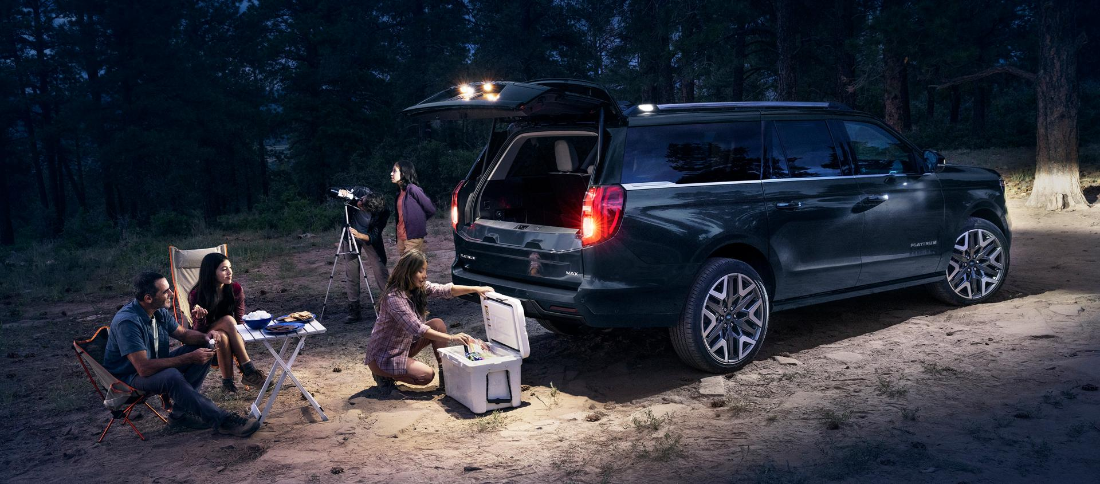
- Camping gear for a group: tents, coolers, folding chairs, gear for 4-6 people
- Home Depot run — several sheets of plywood at an angle, lumber, drywall
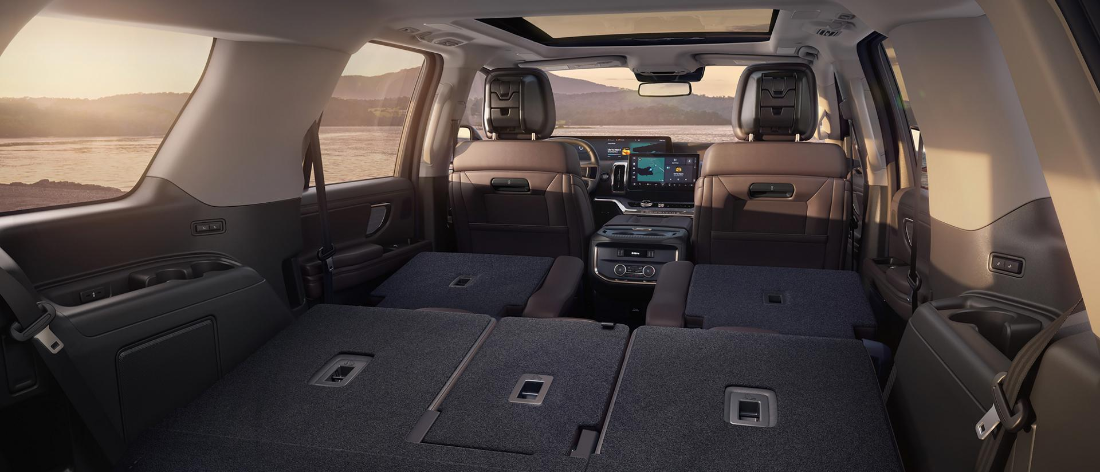
All seats folded, max cargo (108.5 cu ft)
This is genuine small-apartment-move or cargo-van-lite capacity:
- A studio apartment's worth of boxes and small furniture in one load
- A loveseat or small sofa (with rear seats down, you have a flat load floor)
- Several bikes fully upright with room to spare
- A full kayak or paddleboard (with tailgate/rear glass closed, depending on length)
- Building materials — full sheets of plywood laid flat, lumber bundles
- Band/DJ equipment — speakers, amps, cases for a small gig
Practical Notes for Estimating Cargo Space in the 2027 Ford Expedition
Cubic footage isn't the whole story
Manufacturers measure cargo volume as the total empty space in a box shape, but real items aren't perfect rectangles. Wheel wells, sloped roofs, and the taper toward the rear window all eat into "usable" space. A general rule of thumb: assume you can practically use about 70-85% of the stated cubic footage for irregularly shaped items like furniture and luggage, closer to 90%+ only for stuff you can stack tightly, like uniform moving boxes.
Measure the actual opening, not just the volume
Total cubic feet doesn't tell you if something will physically fit through the liftgate or door. Before assuming a big item like a mattress, dresser, or appliance will go in, check the liftgate opening height and width, not just the cargo area dimensions, and check the floor-to-ceiling height at the point you're loading, since it's often lower than the max interior height. For the Expedition specifically, look up the load floor length with seats folded — that matters more than cubic feet for anything long and rigid, like lumber, ladders, or kayaks.
Length beats volume for oddly shaped items
A kayak or surfboard might only take up 10-15 cubic feet, but if it's 10+ feet long, cubic footage is irrelevant — what matters is whether the load floor length with the tailgate closed, or the available diagonal space, accommodates it.
Weight capacity is separate from cargo volume
Don't forget the vehicle's payload rating — how much total weight it can carry, including passengers. You can hit a weight limit long before you fill the cubic footage, especially with dense stuff like tile, soil, books, or water.
Measure your own items before assuming
For anything big, like a mattress, sofa, or appliance, measure its actual boxed or wrapped dimensions (length, width, height) and compare against the liftgate opening, the floor length with seats folded, and the height clearance at the rear versus mid-cabin, since the roofline often slopes down toward the back.
Visit our dealership today to learn more about the 2027 Ford Explorer and speak with our team!